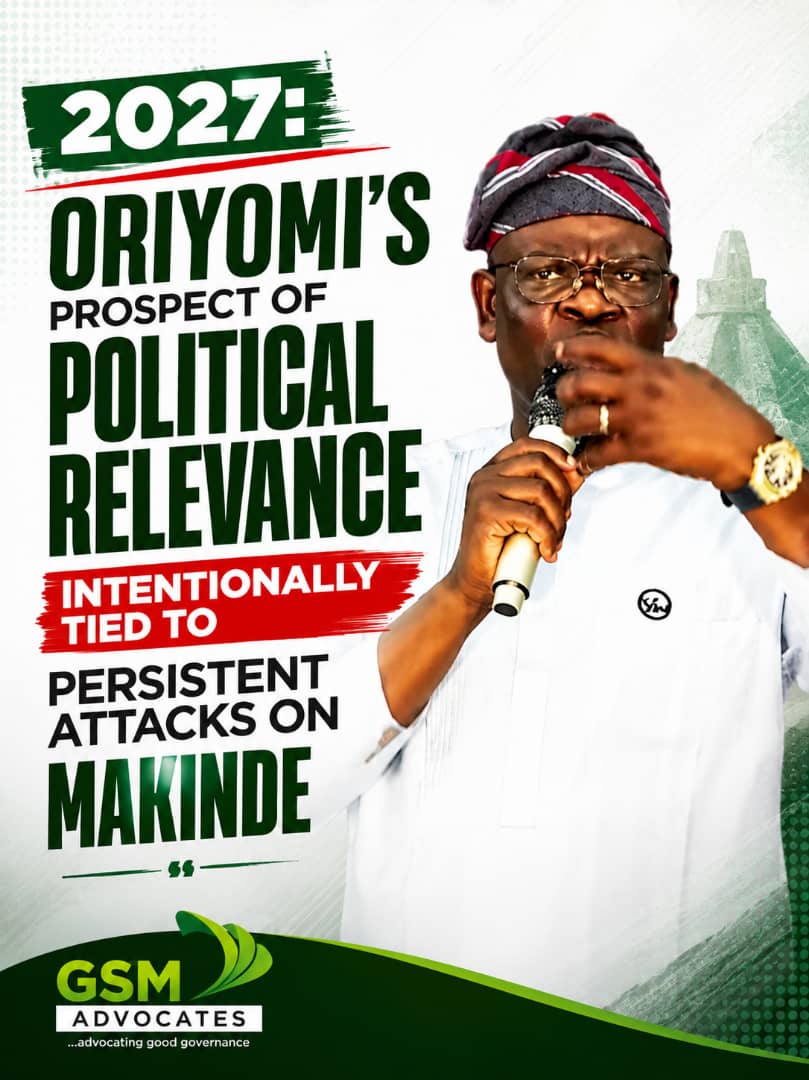
A prominent socio-political group in Oyo state, GSM Advocates, has alleged that the political relevance being sought by radio broadcaster, Oriyomi Hamzat, ahead of the 2027 elections is being deliberately tied to his persistent attacks on Oyo State Governor, Seyi Makinde.
The group made the assertion while reacting to what it described as the celebration by Oriyomi’s followers following Governor Makinde’s remarks at the Hijrah 1448 Luncheon held on Monday.
The GSM Advocates Correspondent, Akanbi Abiola made this disclosure in a statement on Tuesday, August 11, where political actors were called upon to resort to issues based campaign rather than political blackmailing.
Makinde had, during the event, cautioned Oriyomi against concentrating on personal attacks on his person, urging him instead to tell the people his plans, programmes and agenda for the state if given the opportunity to participate in governance.
Reacting to the development, GSM Advocates said the reaction of Oriyomi’s followers to the governor’s remarks was another evidence that the broadcaster’s repeated attacks on Makinde were calculated to provoke a response from the governor.
According to the group, “The celebration that greeted Governor Makinde’s remarks by Oriyomi’s followers is another clear evidence that the persistent attacks on the governor have been calculated to get him to react, thereby making Oriyomi an item for serious political discussion.”
The group argued that if the objective of Oriyomi’s interventions was genuinely to contribute to the political discourse in Oyo State, he should be presenting concrete policy alternatives and explaining what he would do differently rather than making the governor the central subject of nearly all of his political messaging.
GSM Advocates also questioned what it described as the tendency of Oriyomi and his supporters to equate popularity on radio with political relevance.
The group said political popularity was fundamentally different from the ability to host a successful radio programme, stressing that electoral relevance was ultimately determined by the ability to convince voters through credible ideas, policy proposals, character and capacity for leadership.
“How have Oriyomi and his followers continued to mistake political popularity for that of a radio show?” the group asked.
It advised the broadcaster and his supporters to abandon what it described as an “old-fashioned style of politicking” in which repeated allegations, half-truths and outright falsehoods are allegedly presented as facts in the hope that members of the public would eventually accept them.
The group said the increasing sophistication of the electorate meant that political actors could no longer rely solely on sensational claims or persistent attacks to secure public support.
GSM Advocates maintained that the 2027 political contest would be determined by issues that directly affect the people, including economic opportunities, infrastructure, education, healthcare, security, employment and effective governance.
It therefore challenged Oriyomi and other emerging political actors to put their political programmes before the people and allow voters to make their judgment based on competing ideas.
The group added that criticism remained an essential component of democracy, but insisted that such criticism must be founded on facts and constructive alternatives rather than what it described as a sustained campaign of personal attacks.
It further argued that Governor Makinde’s response to Oriyomi should be seen as a reminder that those seeking public office or political influence must be prepared to explain what they intend to offer the people not by engaging in political blackmail to score undeserved points.
GSM Advocates urged the people of Oyo State to scrutinise political claims with verifiable evidence ahead of 2027 and distinguish between genuine political advocacy and attempts to manufacture relevance through controversy.
The group maintained that whoever seeks the confidence of the electorate in 2027 must be prepared to present a clear vision contained in an economic blueprints for the state, rather than making opposition to an individual the central plank of his or her political identity.