Governor Seyi Makinde’s administration has repositioned Oyo State for sustained growth through two strategic policy documents and a series of sectoral reforms, a governance group, GSM Advocates, has said.
In a detailed statement issued on Monday in Ibadan, the group said the Roadmap for Accelerated Development, 2019-2023 and the Roadmap for Sustainable Development, 2023-2027 provided the government with a clear compass, while targeted policies delivered the visible changes across the state.

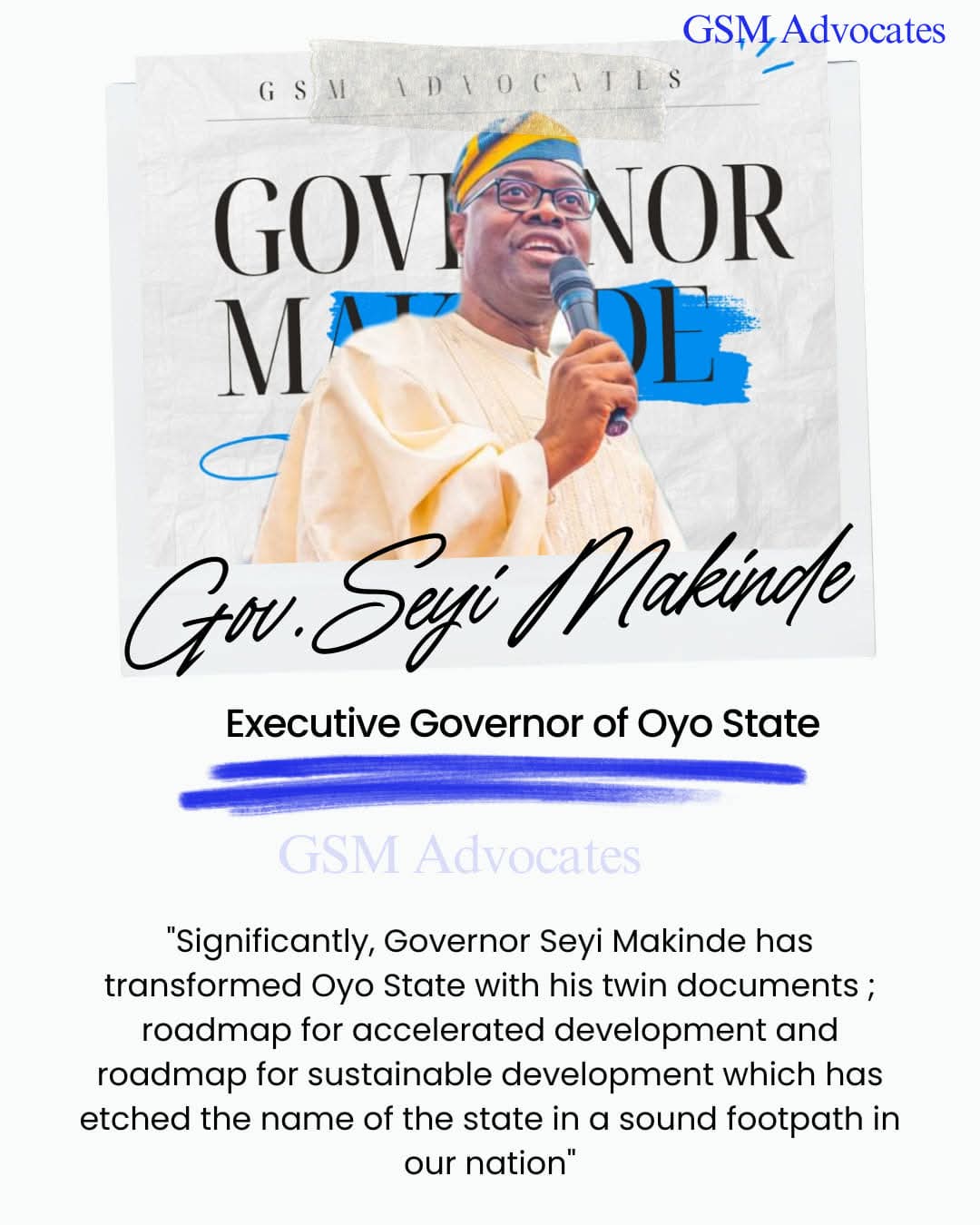
“Significantly, Governor Seyi Makinde has transformed Oyo State with his twin documents; the Roadmap for Accelerated Development and the Roadmap for Sustainable Development, which has etched the name of the state on a sound footpath in our nation,” the group stated.
GSM Advocates explained that the first roadmap was designed for speed and immediate impact. It focused on the administration’s four pillars: Education, Healthcare, Security, and Economic Expansion through Agriculture.
The second roadmap, it added, is focused on consolidation, inclusion and resilience, with emphasis on agribusiness, solid minerals, the digital economy, and climate-smart infrastructure to ensure that projects outlive the current administration.
“The first roadmap restored public confidence. The second is building institutions and systems that will last beyond 2027,” the group said.

The Advocates pointed to several policies it said have changed the state’s outlook; In education, the government scrapped the N3,000 levy in public secondary schools, recruited 7,000 teachers and 692 education officers, and remodeled over 600 primary and secondary schools. The Teaching Service Commission, TESCOM, was also reactivated to improve teacher recruitment and welfare.
In health, 351 Primary Health Care Centres were upgraded to 24-hour facilities with solar power, staff quarters and essential drugs, one in each political ward. Secondary hospitals across the 33 LGAs were also remodeled under the Omololu-Olunloyo Hospital Upgrade Project.
On infrastructure, the administration delivered over 300 kilometres of roads. Major projects listed include the 65km Moniya-Iseyin Road, the 21km Airport-Ajibode-Olodo Road, and ongoing work on sections of the 110km Ibadan Circular Road aimed at easing traffic and opening up new economic corridors.

Operation Burst funded the Oyo State Security Trust Fund, and procured 100 patrol vehicles and 200 motorcycles for security agencies. The group said this improved response time and contributed to a reduction in violent crime.
In agriculture, the Oyo State Agribusiness Development Agency, OYSADA, revived the Fasola, Eruwa and Ijaiye Agribusiness Hubs. Over 30,000 farmers received inputs, mechanization support and training, with the state targeting a stronger position as the food basket of the Southwest.
On the civil service and economy, the administration implemented the N30,000 minimum wage, cleared backlog of promotions, and paid wage awards. A revenue automation drive also helped grow the state’s Internally Generated Revenue, IGR, in recent years.
For GSM Advocates, the conversation around Governor Seyi Makinde’s legacy is now shifting from what has been done to what comes next.
The group said Omituntun 3.0 represents the consolidation phase, a period to move from policy frameworks to full-scale impact in every senatorial district. Key areas listed include completion of the Ibadan Circular Road, expansion of farm settlements, 24-hour operation of all upgraded PHCs, and wider rollout of digital skills programs.
“What is to come on Omituntun 3.0 is what the good people of Oyo State will love to see,” the group said, arguing that residents will feel the difference in their daily lives through better roads, cheaper food from state-supported agriculture, and more economic opportunities.
GSM Advocates argued that the link between the two roadmaps and the policies is what sets Oyo apart from other states.
“The twin roadmaps moved governance from ad-hoc projects to planned, measurable development. That is why Oyo is now being referenced nationally as a model for sub-national governance,”