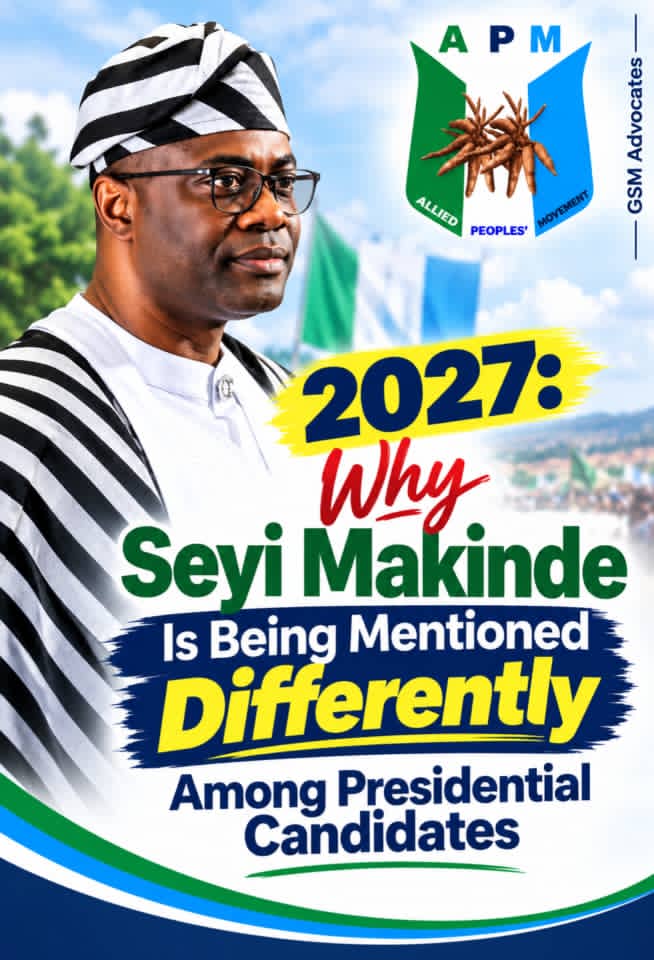
While most presidential hopefuls in Nigeria campaign on what they will do, one name is being debated on the basis of what he has already done.
Seyi Makinde, 58, a two-term governor of Oyo State, has no federal cabinet record. He has no decades in the National Assembly. What he has is 7 years of roads, budget reports, and town halls in one of Nigeria’s largest states and that, for a growing number of Nigerians, is exactly the point.

In a field that already includes veteran federal politicians, former ministers, and established party stalwarts, Makinde is being framed differently by voters, analysts, and civil society groups. The refrain is consistent: he is being judged less on political pedigree and more on a record of subnational governance.
The question driving the discussion is simple. In a country of more than 220 million people, with deep security, economic, and structural challenges, can a governor’s performance become a national argument?
Makinde entered politics after a successful career in engineering and business. That background continues to define his public image. Unlike career politicians whose campaigns rely heavily on party structures, Makinde’s messaging has centered on data, budgeting, and measurable outcomes. His administration publishes quarterly budget performance reports and holds periodic town-hall meetings across Oyo’s 33 local government areas.
Dr. Ayo Aluko, a public policy lecturer puts it this way: “For many Nigerians, especially the under-40 demographic, the appeal is managerial. They are asking: who can manage a complex system? Makinde’s pitch is that he has managed both a private enterprise and a state with 5.5 million people.”

That technocratic framing resonates at a time when Nigeria faces inflation, debt servicing pressure, and demands for efficiency in public spending.
In Ibadan, the state capital, and in towns like Ogbomoso,Ibarapa, Iseyin, and Oyo, residents point to roads, schools, and health facilities as tangible evidence of governance.
Key projects frequently cited include the ongoing Ibadan Circular Road, upgrades to primary healthcare centers, and investments in technical education. For a population accustomed to campaign promises, physical projects have become a form of political communication.
“People are tired of manifestos they never see,” said Funke Adeyemi, a market leader in Osogbo. “When you can drive on a road that was not there 4 years ago, that stays with you.”
That visibility matters nationally because voters in other states are asking whether the same model can be scaled.
Nigeria’s political discourse has grown increasingly combative online and offline. Makinde’s public communication has, by contrast, remained largely issue-focused.
He has appointed younger officials to cabinet positions, invested in agribusiness and tech initiatives, and maintained working relations with traditional institutions, including the Olubadan-in-Council, even during periods of disagreement.
Political communications strategist Nkechi Okeke notes, “The public is exhausted by insults and ethnic baiting. Makinde’s style reads as calmer. Whether that holds under the pressure of a national campaign is another question, but right now it reads as different.”
On platforms like X, TikTok, and Facebook, clips of his town halls and policy explanations circulate widely, often with commentary comparing him to older-generation politicians.
Makinde has been one of the more consistent voices among governors calling for restructuring, state police, and greater fiscal autonomy for states. In a federation where many citizens feel that Abuja controls too much, that position has given him an ideological marker distinct from candidates who defend the current centralized structure.
“His argument is that Nigeria will work better if states have more power to solve local problems,” said a senior APM official in Abuja. “That appeals to voters in the Middle Belt, South East, and South South who feel underserved by the center.”
It also creates a policy contrast with candidates whose careers were built within federal institutions.
Political analyst Jibrin Ibrahim of the Centre for Democracy and Development said:
“Performance in Oyo gives him a story to tell. But a presidential election in Nigeria is also about coalition building, regional balancing, and party dynamics. That test is still ahead.”
Across the country, the word most often attached to Makinde in focus groups and on social media is “different.” It is not used to mean flawless. It is used to mean “an alternative template.”
In Enugu, a 24-year-old first-time voter said: “We keep recycling the same names. This one ran a state and we can check the results.”
In Kano, a civil servant said: “I don’t agree with all his party, but I like that he talks about how money is spent.”
That sentiment reflects a broader voter fatigue with personality-driven politics and a growing demand for track records.
Makinde’s emergence in the conversation already signals a shift. For the first time in several cycles, a sitting governor is being discussed nationally primarily on the basis of state-level delivery rather than federal connections.
In that sense, Makinde represents a test case for Nigerian democracy: can performance at the subnational level translate into viability at the national level?
If Oyo was the pilot, Nigeria is the main test.
Makinde’s records are there, in infrastructure, transparency, and public engagement, that has given him a national talking point that most candidates don’t have.
The issue now is scale. Can what worked in one state be applied to 36 states and a complex economy? He doesn’t rely on legacy or godfathers. He relies on results.
That shift is why he stands out. He’s making the 2027 conversation less about power and more about performance
Bashorun Saintabey is an author, researcher, and public intellectual. He writes and speaks on governance, values, and community development, with a mission to shape conversations that drive responsible leadership and societal progress.